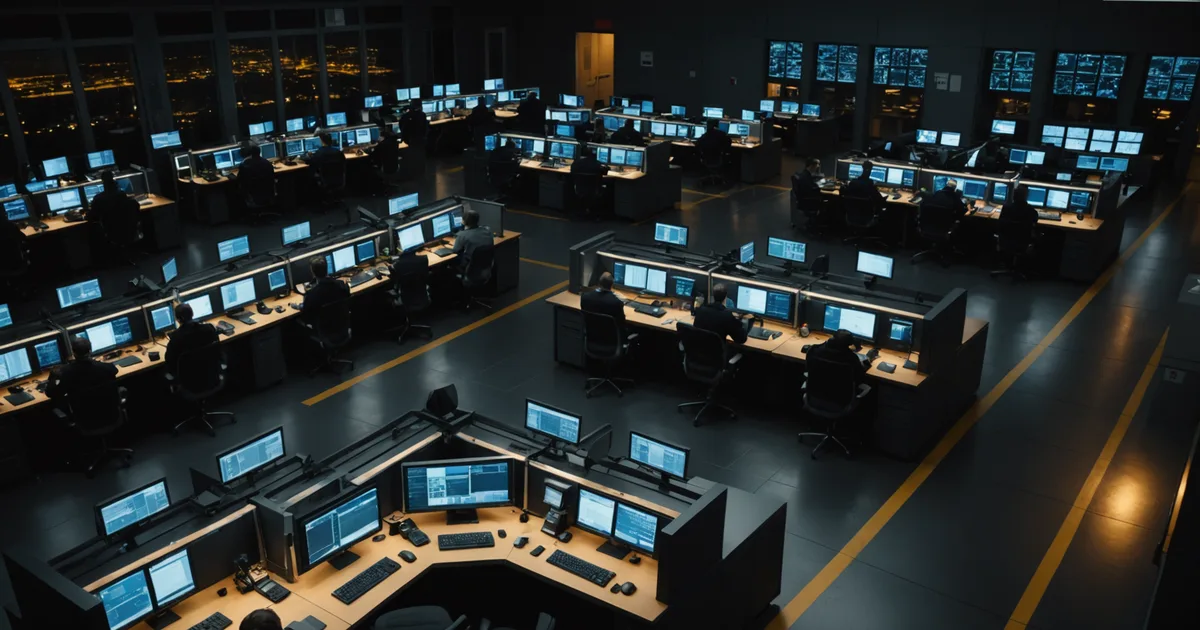
Spending a lot of time talking to monitoring center operators in the first half of 2025 made one thing clear: the operational pressures that have been building for the better part of a decade have moved from "anticipated future problem" to "current daily reality." Alert volume is up. Staffing constraints have not loosened. False alarm rates remain stubbornly high in commercial accounts. And the tools that most centers are using to manage the call queue are the same tools they were using five years ago.
Three patterns have emerged from these conversations and from observing how different types of centers are responding to the same underlying pressures. None of these are universal. But they appear consistently enough across different ARCs, different account portfolios, and different geographies that they are worth naming clearly.
Pattern 1: Alert Volume Growth Is Structural, Not Cyclical
The alert volume that monitoring centers are managing today is higher than it was three years ago, and the growth does not appear to be slowing. The drivers are partly the expansion of sensor networks into account types and premises sizes that were previously too small to warrant full security monitoring (smaller commercial units, short-term rental properties, solo-operator retail). More accounts means more alerts, and smaller accounts often have less well-maintained sensor infrastructure than larger commercial customers with dedicated facilities teams.
There is also a technology driver. Integrated smart building systems are generating monitoring events from non-traditional sensor types: temperature deviations, HVAC anomalies, water ingress sensors, power supply alerts. These are legitimate monitoring use cases, but they are generating call volume against the same overnight staffing that was sized for traditional intrusion and fire monitoring. The monitoring center that signed up to cover 400 commercial accounts three years ago may effectively be covering the alert output of 600 by now, as each account's connected system footprint expands.
Centers that are treating this as a transient spike are finding themselves perpetually catching up. The centers that have responded by treating it as a structural shift are building triage capacity that scales with volume rather than adding dispatcher headcount proportionally. The economics of adding overnight staff are not favorable at any point in the growth curve. The practical ceiling is low.
Pattern 2: The False Alarm Problem Is a Data Quality Problem, Not Just an Equipment Problem
The conventional framing of high false alarm rates is that account holders have poorly maintained or incorrectly installed equipment. This is true as far as it goes. But the monitoring centers with the most persistent false alarm problems are often the ones whose account data profiles have drifted furthest from the operational reality of their accounts.
An account profile that still lists a keyholder who left the company 18 months ago, with a response phone number that no longer reaches anyone, is not just an administrative problem. It is a triage problem. The monitoring center's ability to confirm or deny an alert quickly depends on being able to reach someone who knows the premises. When the first contact on the keyholder list has been changed but not updated in the account profile, the triage call fails at step one: the person who answers does not know the alarm is at a premises they are no longer associated with, or the call goes to voicemail at 3am.
Several centers have moved to systematic account data audits as a deliberate operational practice, not just as part of annual contract renewal. Keeping keyholder data current has a measurable effect on the percentage of overnight alerts that can be resolved without emergency service dispatch. The accounts with clean, current profiles have shorter triage call times and higher keyholder confirmation rates. This is not a surprising finding, but many centers had not quantified the relationship until they started measuring it.
Pattern 3: Overnight Triage Automation Is Moving from Experiment to Standard
The most significant operational shift we have observed in the past 18 months is that automated pre-screening of overnight calls is moving from something a few early-adopting centers are testing to something a meaningful share of mid-size and growing ARCs are actively planning or deploying. The category of "we tried basic IVR and it did not work, therefore automation does not work" is giving way to a more nuanced view of what automated overnight triage actually requires.
The distinction that centers have arrived at through experience is between passive routing (which is what IVR provides) and active triage (which requires a conversational exchange that gathers information and makes a classification decision based on caller responses). The centers that tried IVR-based automation and abandoned it were correct that it did not meet their needs. They were drawing the wrong lesson when they concluded that automation in general was not viable for overnight triage. What they could not do with an IVR menu, a voice agent that conducts a structured classification conversation can do.
The adoption is not uniform. Centers covering complex, high-sensitivity account portfolios, such as critical national infrastructure or financial services premises, are moving more slowly and with more careful validation before deployment. Centers covering general commercial portfolios are finding the case for overnight triage automation straightforward once they see the operational data from a pilot. The false positive classification accuracy, the reduction in dispatcher queue load during the 2am to 5am window, and the consistent call summary records are all visible in the first weeks of operation.
What This Means for Centers Still Evaluating
The centers that have yet to deploy any form of automated overnight triage are now evaluating against a baseline that includes peer operators who have operational data to share, not just vendor claims. That changes the evaluation conversation. A center that can compare their overnight dispatcher utilization rates and false alarm escalation volumes against a comparable center that has deployed voice triage is working from facts rather than projections.
The risk profile of adopting has also changed. The early pilots showed what the failure modes looked like and how to manage them. Escalation fallback design, dispatcher integration, call summary format, and override mechanisms have all been tested in live overnight environments. The centers evaluating now are not inheriting untested designs.
The Common Thread Across All Three Patterns
What connects all three patterns is that the monitoring centers absorbing the most pressure are the ones that have not updated their operational approach to account for structural changes in their environment. Alert volume is structurally higher and will stay higher. Account data quality is a continuous operational discipline, not a one-time setup task. And the tools available for overnight call management are now genuinely different from what was available five years ago.
Centers that are still operating on the assumption that the environment is the same as it was in 2019 are experiencing the same pressures as everyone else and managing them with less adapted tools. That gap is widening, not narrowing.
We are not arguing that voice triage automation is the only response to these pressures. Staffing improvements, sensor maintenance programs, and account data hygiene are all real levers. But addressing overnight call volume, which is the most acute and immediate pressure for most centers, without any automated pre-screening layer is increasingly difficult to defend operationally when the operational data from centers that have deployed it is now available and consistent.