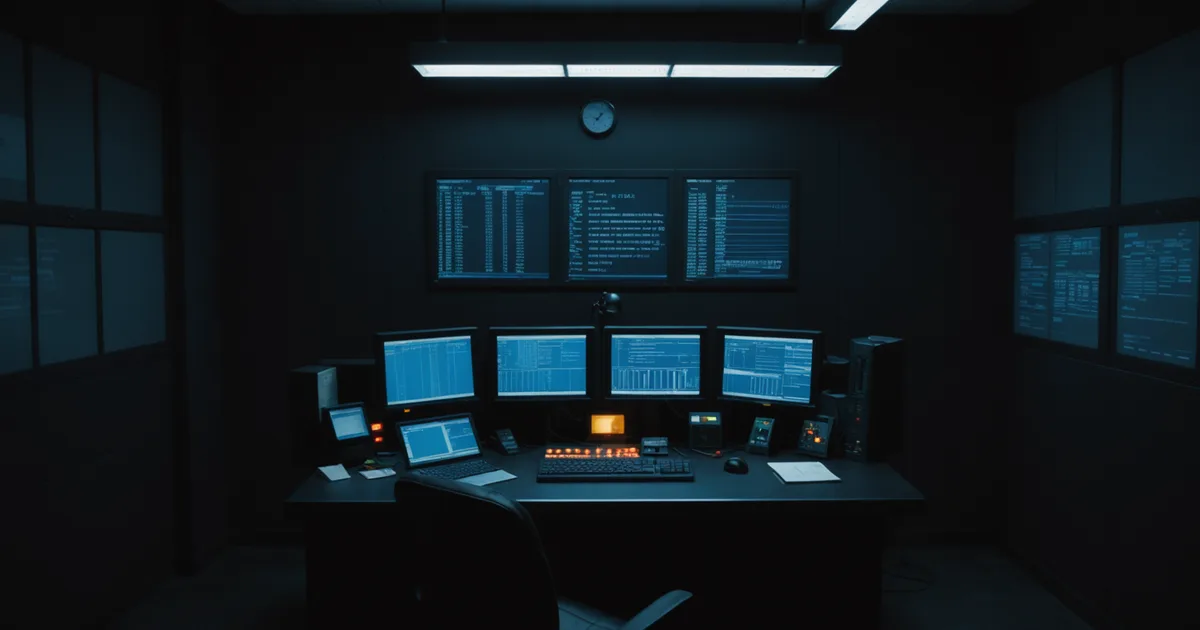
The term "24-hour monitoring" is accurate in a narrow sense. Monitoring centers are staffed around the clock. The phone gets answered at 3am. What the term obscures is that the coverage delivered at 3am is structurally different from the coverage delivered at 3pm, in ways that matter for the security and operations managers whose accounts depend on it.
The overnight coverage gap is not usually a staffing failure in the sense of nobody being present. It is a capacity and quality gap: fewer people handling the same volume, often more tired, with less supervisory support, against a call queue that is disproportionately skewed toward false positives. Understanding where the gap actually occurs helps in designing responses to it.
The Staffing Arithmetic of the Night Shift
A typical ARC covering several hundred commercial accounts might staff eight to twelve dispatchers during peak daytime hours, covering a queue that also peaks during that period. Meetings happen, supervisors are available, quality review happens in real time. The overnight shift, for the same account portfolio, might have two or three dispatchers handling a call volume that is lower in absolute terms but often higher in false-positive density.
The arithmetic problem is that overnight staffing ratios cannot simply be scaled down proportionally to overnight call volume. A monitoring center with one dispatcher on shift cannot handle a simultaneous event cluster, where a power fluctuation or a weather event triggers alarms across dozens of accounts at once. A single dispatcher handling 20 simultaneous queue entries is not providing monitoring. They are managing triage at a speed that prevents any individual call from receiving genuine attention.
Most centers know this. They maintain minimum overnight staffing levels that protect against the simultaneous event scenario. But minimum staffing is exactly that: minimum. The margin for handling routine volume while maintaining readiness for a genuine incident cluster is thin in the 2am to 5am window. That is when the coverage gap is widest.
Keyholder Response Rates at Night
A significant portion of overnight coverage quality depends on keyholder response, and keyholder response rates drop substantially between midnight and 6am. When a center confirms an alert warrants human inspection and attempts to contact the account's designated keyholder, a keyholder who does not answer is not a failed confirmation. It is a dispatch decision that has to be made on less information.
The practical effect on overnight coverage: a higher proportion of genuinely ambiguous events, where triage confirmed something abnormal but keyholder verification was not possible, must be resolved through more conservative escalation assumptions. Either dispatching emergency services on less confirmation than would typically be required, or logging the event and attempting keyholder contact again before dispatching.
Neither outcome is ideal. Dispatching on less confirmation increases unnecessary emergency service callouts. Delaying dispatch to attempt additional keyholder contact increases the risk of a delayed response to a genuine incident. Both are real costs of the overnight coverage gap that do not appear in the call volume statistics.
The Queue Quality Problem After Midnight
Overnight call queues at ARCs have a specific quality profile that is different from daytime queues. During business hours, the false alarm rate from commercial accounts is lower. People are present at the premises. An alarm event triggers a human response from within the building before the monitoring center is typically called. Many false alarms are cancelled before they generate an ARC callout at all.
After midnight, premises are empty. There is nobody on site to cancel an alarm triggered by a door contact misaligned by the building cooling overnight. There is nobody to notice that the PIR in the server room corridor has been misfiring for three weeks because the cleaning contractor changed their route. Every one of those events generates a monitoring center call. The overnight dispatcher processes a queue that is a much higher concentration of false positives than the daytime equivalent, without the context that a on-site person would provide.
The result is that overnight dispatchers are applying experienced judgment to a queue where the vast majority of that judgment produces the same outcome. The quality of attention available for the genuine events is partially consumed by the mechanical processing of the non-events.
The Hidden Cost: Response Time Variance
One metric that monitoring center operations reports rarely surface is response time variance across the day. Average response time to confirmed escalation events is a standard metric. Variance in that response time, by hour of day, tells a different story.
The variance is typically higher overnight. A confirmed escalation at 2pm, with full daytime staffing and supervisor coverage, is likely to follow the standard protocol efficiently. A confirmed escalation at 3am, handled by a dispatcher who has been processing high-volume false positives for four hours, is more likely to show a wider range of response times. Some will be handled quickly. Some will be slower than the standard. That variance is the operational signature of the coverage gap.
We are not saying this is a failure of individual dispatchers. It is a structural feature of how overnight coverage is organised and what it asks of the people doing it.
Where Automated Pre-Screening Changes the Equation
The coverage gap is primarily a capacity and quality-per-call problem, not a presence problem. Addressing it requires either adding capacity (more staff overnight) or reducing the mechanical load on existing capacity. Adding staff overnight is an option that most monitoring centers have already fully exploited within their economic constraints. Reducing the mechanical load is the lever that has not been fully pulled.
When automated triage handles the initial contact on overnight false positive calls before they reach the primary queue, the effect on the dispatcher is not just workload reduction. It is a change in the nature of what they are asked to do. The overnight queue becomes a set of calls that cleared an initial filter. The dispatcher is making substantive decisions more often and routine decisions less often. Their cognitive reserves, which are finite and deplete over a shift, are preserved for the genuinely demanding events.
This does not eliminate the overnight coverage gap. Minimum staffing requirements, keyholder response limitations, and simultaneous event risks remain real. But it changes the quality of coverage that the existing overnight staff can provide, which is the part of the gap that is directly addressable without significant additional cost.
What Good Overnight Coverage Actually Requires
The monitoring centers that deliver consistent overnight coverage quality are not the ones with the most staff per account. They are the ones that have systematically reduced the mechanical load on their overnight team, maintained clean account profiles so triage conversations are accurate, and built escalation workflows that dispatchers trust. The combination of those elements is what makes the difference between overnight coverage that is nominally 24-hour and overnight coverage that actually delivers on that promise.